
Bonds vs. Insurance: Who, What, When, Where & Why?!
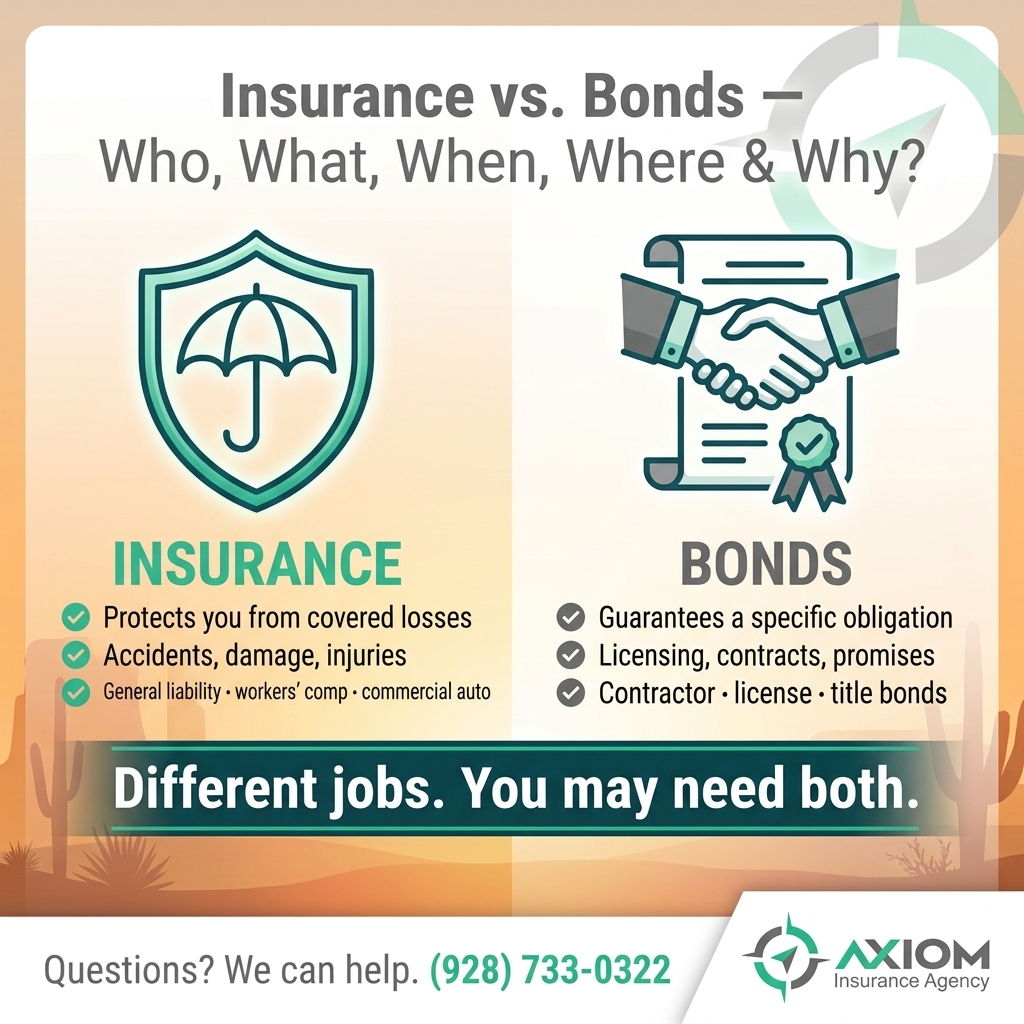
Quick Summary: Bonds and insurance may look alike because both involve an insurance professional and a premium, but they solve very different problems. Insurance is designed to protect you from covered losses. A surety bond is designed to protect the public, a customer, or another party if you fail to meet a legal, financial, or contractual obligation. In many real-world situations—especially for Arizona contractors and business owners—you may need both.
At Axiom Insurance Agency, we help Arizona businesses sort through the fine print so they can focus on the work, not the “Wait…who is protected here?” moment.
The Big Difference: Who Is Being Protected?
Think of insurance as your financial safety net. If your work van damages a client’s gate, your employee gets hurt on the job, or a monsoon tears part of the roof off your office, the right insurance policy may help pay for a covered loss. General liability, commercial property, workers’ compensation, commercial auto, and builders risk insurance are all examples of protection purchased primarily for the insured business or individual.
A bond is more like a promise backed by a surety company. There are usually three parties: the principal (the person or business that must obtain the bond), the obligee (the party requiring the bond), and the surety (the company guaranteeing the obligation). If the principal does not meet the obligation and a valid claim is paid, the principal may be responsible for repaying the surety.
In other words: insurance expects that accidents can happen. A bond expects you to perform as promised.
Claim Scenario: The Contractor Who Thought a Bond Was Liability Insurance
Imagine a Lake Havasu contractor installing a patio cover. During the job, a ladder slips and smashes a homeowner’s glass door. That is the kind of unexpected property damage that may fall under a covered general liability claim—not a contractor license bond claim.
Now imagine a different problem: the contractor takes a deposit, starts the work, abandons the project, and fails to complete the job according to applicable requirements. A contractor license bond may be relevant to the customer’s recourse, depending on the facts and applicable rules. The bond is not there to repair every accidental loss; it supports the contractor’s promise to meet licensing and performance obligations.
That is why “bonded and insured” should never be treated as one interchangeable phrase. It usually means two separate protections with two separate jobs.
When Insurance Is the Right Answer
Insurance is generally the better fit when the concern is an accidental, sudden, or covered loss to your own business or a third party. A few common examples include:
- Property damage or bodily injury: A customer trips over tools at a jobsite. General liability may respond to a covered claim.
- Employee injuries: A crew member strains a shoulder lifting materials. Workers’ compensation may provide benefits, subject to the policy and state requirements.
- Damage to your building, equipment, or inventory: A fire, theft, or storm damages covered business property. Commercial property insurance may help.
- Vehicle accidents: A work truck rear-ends another vehicle while traveling between jobs. Commercial auto insurance is the conversation to have.
- Projects under construction: Wind, theft, or other covered damage affects a partially completed project. Builders risk insurance can be especially important for construction work.
Insurance is about managing the financial shock of covered losses. It does not replace a required bond, and a bond does not replace strong commercial insurance.
When a Bond Is the Right Answer
A bond is usually the right tool when a government agency, court, project owner, lender, or customer needs financial assurance that a specific duty will be fulfilled. Here are the situations we see most often:
- You need a professional or contractor license: The state or municipality may require a license bond before issuing or renewing the license.
- You are bidding or working on a construction contract: A project owner may require bid, performance, and payment bonds.
- You need to resolve a vehicle ownership issue: An Arizona bonded title can be part of the process when ownership documentation is incomplete.
- You have a court-appointed responsibility: Probate, guardianship, or other court bonds may be required to protect an estate or beneficiaries.
- Your business handles money or regulated duties: A license, permit, or commercial bond may be required by the agency overseeing that activity.
Claim Scenario: The Bid That Turned Into a Big Promise
A contractor submits a winning bid for a public project, then discovers the estimate missed a major material cost. If a bid bond was required, it can protect the project owner if the contractor refuses to enter the contract or provide the next required bonds. If the contractor proceeds, a performance bond helps assure the work will be completed under the contract, while a payment bond helps protect subcontractors and suppliers from nonpayment.
These bonds do not insure the contractor’s profit margin. They make the contractor’s commitment more credible.
Common Types of Surety Bonds, Explained Simply
License and permit bonds are required by a government body or licensing authority. They help ensure a business follows applicable laws, regulations, and licensing rules. Arizona contractor license bonds are a familiar example for construction businesses.
Contract bonds support construction obligations. Bid bonds back up a bid; performance bonds support completion of the contract; and payment bonds address payment obligations to certain subcontractors and suppliers. These are common on larger private work and public projects.
Contractor license bonds are a specific license bond used by contractors. Arizona bond amounts depend on the license classification and anticipated volume of work. Residential contractors may also have separate financial-protection requirements through the Arizona Registrar of Contractors’ Recovery Fund or an additional bond.
Title bonds, often called bonded title bonds, help with ownership questions involving a vehicle, trailer, or mobile home when standard title documentation is not enough. Arizona’s process includes an inspection and other supporting steps; the required bond amount is generally one and one-half times the vehicle or mobile home value.
Court and probate bonds may be required when someone is appointed to manage another person’s property, estate, or financial affairs. They are intended to protect the people with an interest in the estate or funds.
Fidelity bonds protect a business or organization from certain dishonest acts by employees, such as theft of client funds or property. Although people often group them with surety bonds, fidelity coverage functions more like insurance because it protects the insured organization from a covered employee dishonesty loss.
Arizona Bond Resources and a Simple Next Step
Arizona requirements depend on the bond type, the agency, and your situation. Contractors can review the Arizona Registrar of Contractors’ Bond Information page for current contractor bond limits and guidance. For certain contracting tax requirements, the Arizona Department of Revenue also provides information about contractor bonds. If you need a vehicle or mobile-home title bond, review the Arizona Department of Transportation’s Bonded Title requirements before purchasing a bond.
Need a quick quote or a straightforward starting point? Visit Axiom Insurance Agency’s self-service bond page. We can also help you look at the bigger picture—because the right bond may get you licensed or awarded the job, while the right Arizona insurance coverage helps protect what you have worked hard to build.
FAQ
Does a bond replace general liability insurance?
No. A bond guarantees a specific obligation to another party, while general liability insurance may help protect your business from covered third-party injury or property-damage claims.
Can I need both a bond and insurance?
Absolutely. A contractor may need a state-required license bond, contract bonds for a particular project, general liability insurance, workers’ compensation, commercial auto coverage, and builders risk coverage depending on the work.
Does a bond claim affect me personally?
It can. Surety bonds commonly include an indemnity obligation, meaning the principal may have to repay the surety for valid claim payments and related costs. Review the bond agreement carefully.
Are all Arizona contractor bonds the same amount?
No. Arizona contractor bond requirements vary based on classification and contemplated gross volume of work. Check the current state guidance and confirm the requirement before you buy.
How do I know which bond I need?
Start with the requirement from the agency, court, project owner, or customer. Then bring that language to Axiom Insurance Agency so we can help match the requested bond to the right solution.