
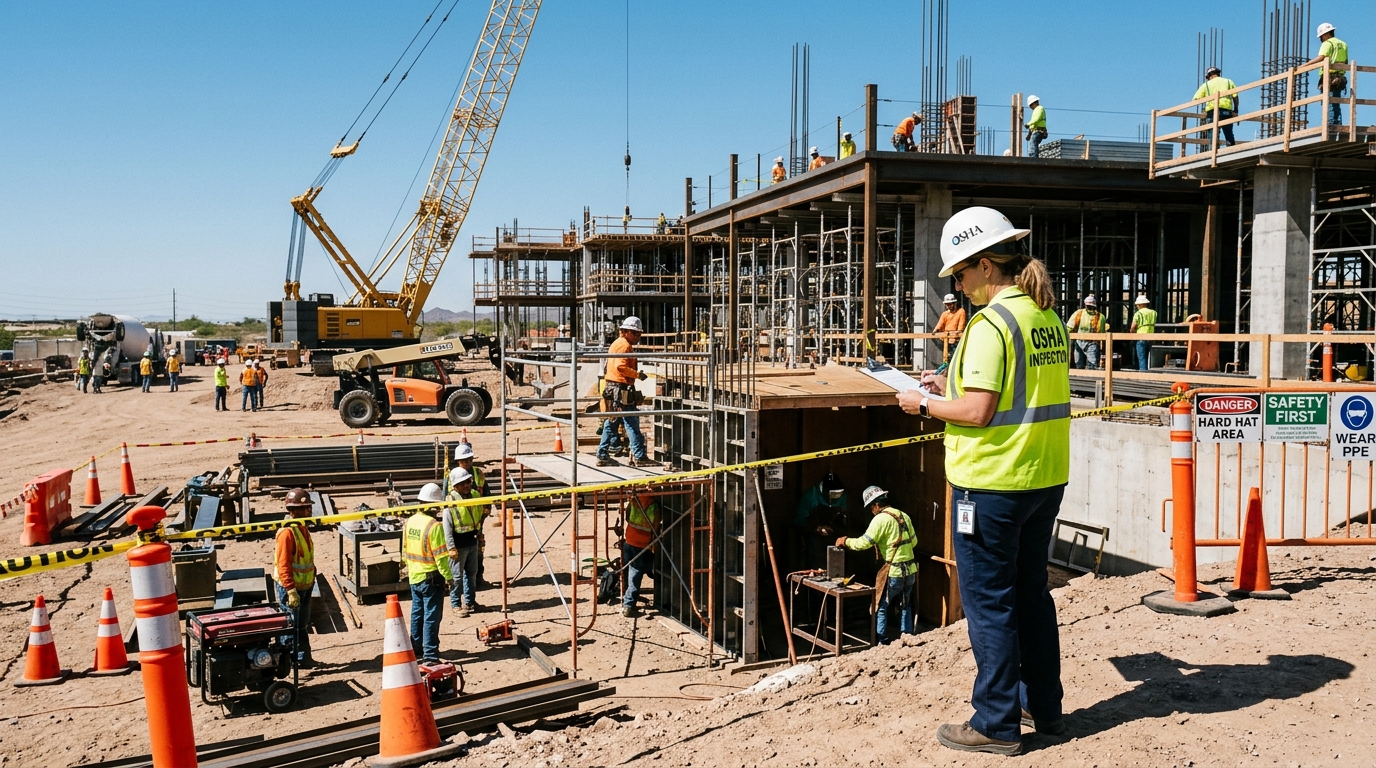
OSHA Rules Arizona Contractors Cannot Afford to Ignore
OSHA compliance is not just paperwork—it is one of the best ways to protect your crew, your reputation, and your business. For Arizona contractors, the basics include jobsite inspections, training, fall protection, chemical safety, and fast reporting after serious incidents. A strong safety program can also help prevent the kind of claims that can disrupt projects and raise insurance costs.
At Axiom Insurance Agency in Lake Havasu City, we specialize in contractor insurance, contractor bonds, and practical guidance for Arizona construction businesses. We help contractors understand insurance requirements, locate useful OSHA and ADOSH forms, and identify safety and education resources when they are needed.
OSHA Basics: What Contractors Are Expected to Do
OSHA is the federal workplace-safety system. In Arizona, most private-sector construction employers work with the Arizona Division of Occupational Safety and Health (ADOSH), Arizona’s OSHA-approved State Plan agency. ADOSH enforces safety requirements, conducts inspections, and can issue citations.
At the simplest level, contractors must provide a workplace that is free from recognized serious hazards. Under OSHA’s general construction safety rule, employers need safety programs, frequent jobsite and equipment inspections by competent people, and properly trained workers operating equipment.
A competent person is someone who can recognize hazards and has authority to correct them. For example, if a trench wall shows cracks or water buildup, the competent person should stop work and make the excavation safe before anyone goes back in.
The Construction Hazards That Create Big Problems
Every contractor’s exposure is different, but several OSHA issues show up again and again:
- Falls: Workers on roofs, scaffolds, ladders, elevated platforms, or unprotected edges may need guardrails, safety nets, or personal fall-arrest systems. Federal construction rules generally require fall protection at six feet or more above a lower level. Review OSHA’s fall-protection standard before assuming a job is too small for the rule to apply.
- Trenching: A trench can collapse without warning. OSHA provides a clear trenching and excavation resource for contractors using protective systems, inspections, and safe entry procedures.
- Chemicals: Paints, solvents, adhesives, fuel, silica dust, and cleaning products may trigger Hazard Communication requirements. This means labels, Safety Data Sheets, employee training, and a written program. OSHA offers a Hazard Communication guide and sample resources.
- Silica: Cutting concrete, block, brick, or stone can create dust that damages lungs. OSHA’s construction silica guidance explains control methods such as wet cutting, vacuum systems, and appropriate respiratory protection.
Claim example: A remodeling contractor cuts dry concrete indoors without dust control. One employee later alleges breathing injuries, while another slips on accumulated dust. A workers’ compensation claim, a possible liability claim, lost work time, and an OSHA citation can all grow out of one avoidable safety gap.
Arizona-Specific Requirements to Watch
Arizona generally incorporates federal OSHA standards, but ADOSH also has state-specific construction and fall-protection standards. That means a contractor should not rely on a generic out-of-state safety checklist. OSHA identifies Arizona as a State Plan with its own enforcement authority and unique standards in areas including construction and fall protection.
Arizona’s residential-construction fall-protection law includes detailed written-plan requirements for work involving fall hazards. The Arizona residential fall-protection statute addresses issues such as written fall-protection plans, qualified persons who prepare the plan, competent persons who supervise it, jobsite copies, and controlled-access zones. Residential roofers, solar installers, framers, and remodelers should pay particular attention.
Arizona contractors should also know what happens after a severe accident. Under ADOSH rules, a work-related fatality must generally be reported within eight hours. An in-patient hospitalization, amputation, or loss of an eye must generally be reported within 24 hours. The official ADOSH severe-injury reporting form and instructions explain when and how to report.
Safety Documentation Is a Business Tool
Good safety documentation helps you train your team, respond to a general contractor’s prequalification request, and show that your company takes risk seriously. Depending on the work you perform, useful records may include toolbox-talk logs, training records, equipment inspections, incident reports, Safety Data Sheets, written Hazard Communication programs, and site-specific fall-protection plans.
If you are unsure where to start, ADOSH offers a free consultation request form. The consultation program is voluntary; identified hazards do not result in citations or penalties, but the employer must agree to correct them. ADOSH also provides a training request form and a central forms page.
Why Contractor Insurance Should Match the Work
Insurance is not a replacement for OSHA compliance. Safety reduces the chance of a loss; insurance helps protect your business when a covered loss still happens. The right contractor insurance program may include general liability, workers’ compensation, commercial auto, tools and equipment coverage, builders risk, umbrella coverage, and other protection based on your operations.
Claim example: An HVAC contractor’s employee is backing a service van at a jobsite and damages a homeowner’s vehicle. Commercial auto coverage may respond to the vehicle loss, while the contractor’s safety procedures—spotters, backup cameras, and clear work zones—help reduce the chance of the incident in the first place.
A specialist understands that an electrician, roofer, excavation contractor, painter, and general contractor do not face the same risks. At Axiom Insurance Agency, we help Arizona contractors review their coverage, insurance certificates, safety-related requirements, and contractor bond needs. We do not just write contractor insurance—we also help with contractor bonds that may be required for licensing, bids, permits, or project contracts.
FAQ
Does OSHA apply to small contractors?
In many cases, yes. A small crew is not automatically exempt from OSHA safety requirements. Recordkeeping rules can vary by company size and industry, but employers still have safety duties and may still need to report severe work-related injuries to ADOSH.
Does a general contractor control every subcontractor’s OSHA duties?
Not always, but multiple employers can have safety responsibilities at the same site. OSHA recommends clear communication about hazards, emergency procedures, and who is responsible for each safety task before work begins.
Where can I find Arizona OSHA forms?
Start with the official ADOSH forms page for consultation, training, reporting, compliance assistance, and other resources.
Can Axiom Insurance Agency help with OSHA questions?
We can help contractors understand common insurance and safety-related requirements, point them toward reputable forms and education resources, and coordinate an insurance program built around their work. For legal or regulatory interpretations, contractors should also consult ADOSH, OSHA, or qualified legal and safety professionals.
Ready to Protect Your Arizona Contracting Business?
Whether you need contractor insurance, workers’ compensation, commercial auto coverage, builders risk, contractor bonds, or help understanding insurance-related safety requirements, Axiom Insurance Agency is ready to help. Request Arizona contractor insurance information or a quote today.